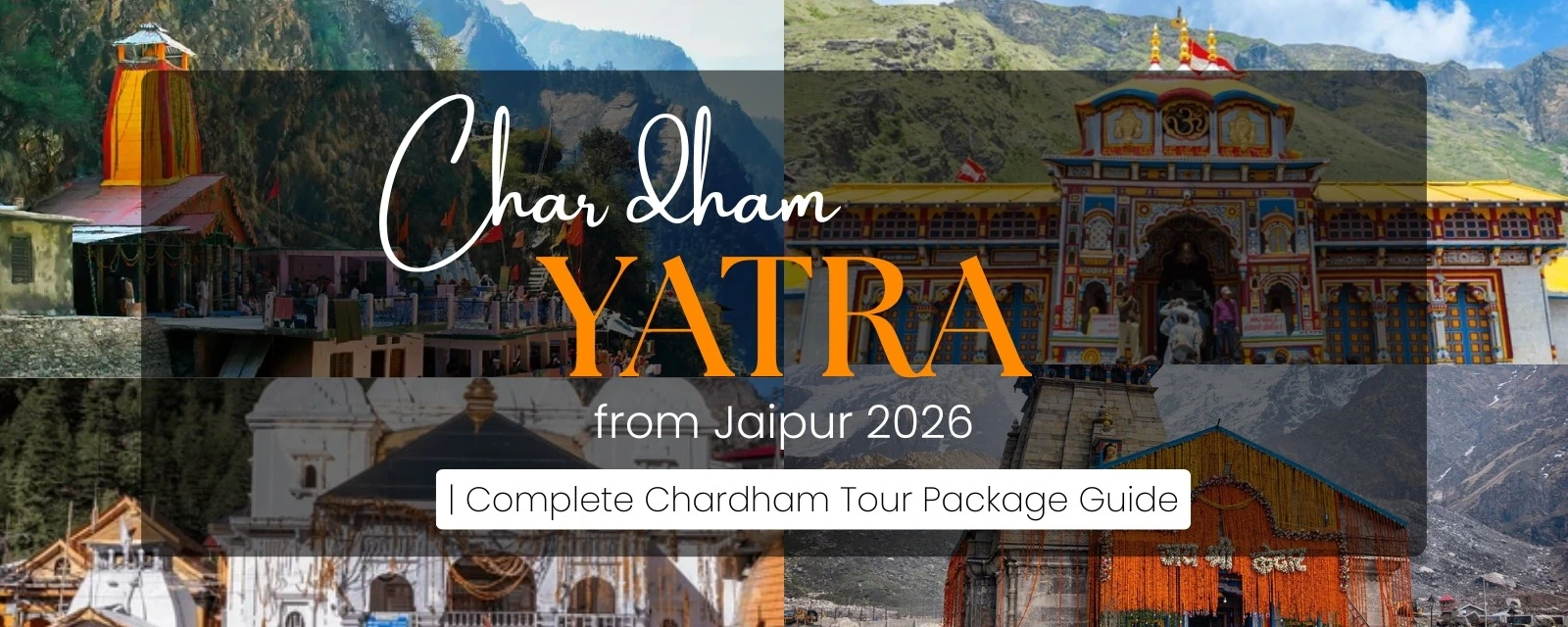
Introduction: Chardham Yatra from Jaipur 2026 | Complete Chardham Tour Package Guide
The Char Dham Yatra from Jaipur is one of the most respected pilgrimage journeys for devotees traveling from Rajasthan to the sacred temples of Uttarakhand. The Char Dham circuit includes four important shrines located in the Garhwal Himalayas — Yamunotri, Gangotri, Kedarnath and Badrinath. Each of these temples holds deep religious significance in Hindu tradition and attracts thousands of pilgrims every year.
A well-planned Char Dham Yatra package from Jaipur generally takes around 12 days. The itinerary is designed to give pilgrims enough time to travel safely through the mountainous terrain while completing temple visits without rushing. Because the route includes both highway travel and high-altitude roads, many travellers prefer organised transportation such as Vehicle Etios, Swift Dzire (Sedan), Innova Crysta, Tempoo Traveller and Urbania, tempo travellers or group vehicles.
Apart from its religious importance, the Char Dham Yatra also offers travellers an opportunity to explore the natural beauty of Uttarakhand. Snow-covered peaks, flowing rivers, forests and quiet mountain towns make the journey memorable for both pilgrims and travellers.
What is Chardham Yatra?
The Char Dham Yatra refers to a pilgrimage that connects four sacred temples located in the Himalayan region of Uttarakhand. These temples are collectively known as the Char Dham of North India and are associated with different Hindu deities and sacred rivers. .
The four temples included in the pilgrimage are:
- Yamunotri – dedicated to Goddess Yamuna
- Gangotri – dedicated to Goddess Ganga
- Kedarnath – dedicated to Lord Shiva
- Badrinath – dedicated to Lord Vishnu
Traditionally, the pilgrimage begins with Yamunotri and ends at Badrinath. This sequence follows the geographical flow of the rivers and the traditional order followed by pilgrims for centuries.
Completing the Char Dham Yatra from Jaipur is considered spiritually meaningful. Many devotees believe that visiting these temples helps cleanse the soul and brings divine blessings. Apart from religious reasons, the journey is also known for its scenic landscapes and historic pilgrimage routes that have been used for generations.
Char Dham Temples — What You Need to Know Before You Go
Each temple in the Char Dham circuit is located in a different valley of the Garhwal Himalayas. These temples are surrounded by mountains, rivers and forests, which adds to their spiritual atmosphere.
Yamunotri Temple
Yamunotri is the first temple visited during the Char Dham pilgrimage. The temple is dedicated to Goddess Yamuna, the river goddess believed to be the daughter of the Sun God.
Located at an altitude of about 3,293 meters, Yamunotri lies in a narrow valley surrounded by snow-covered peaks. The temple itself is small but holds great religious importance.
Travellers starting the Yamunotri Yatra from Jaipur usually drive to a small town called Janki Chatti, which serves as the base point for the temple. From Janki Chatti, pilgrims complete a 6 kilometre trek to reach the shrine. Pony rides and palanquins are also available for those who cannot trek.
One of the unique features of Yamunotri is the presence of natural hot water springs. Pilgrims often cook rice or potatoes in the hot water as an offering before entering the temple.
Gangotri Temple
Gangotri Temple is the second destination in the Char Dham pilgrimage. The temple is dedicated to Goddess Ganga, the river considered sacred in Hindu culture.
The temple stands at an altitude of about 3,100 meters along the banks of the Bhagirathi River. The surrounding landscape includes pine forests, rocky mountains and glacial streams.
The Gangotri Yatra from Jaipur passes through the town of Uttarkashi, which is an important stop for pilgrims. From Uttarkashi, the road continues along the Bhagirathi valley until reaching Gangotri.
Many travellers also visit nearby places such as Harsil Valley, which is known for its peaceful environment and scenic mountain views. Another important location is Gaumukh Glacier, considered the physical source of the River Ganga.
Kedarnath Temple
Kedarnath Temple is one of the most important temples dedicated to Lord Shiva and is also one of the twelve Jyotirlingas mentioned in Hindu scriptures.
The temple is located at an altitude of approximately 3,583 meters and is surrounded by some of the highest peaks in the Garhwal Himalayas. The Mandakini River flows near the temple, adding to the spiritual atmosphere of the region.
For pilgrims undertaking the Kedarnath Yatra from Jaipur, the journey usually continues to Sonprayag and then to Gaurikund, which serves as the base for the trek.
From Gaurikund, travellers complete a 16–18 kilometre trek to reach the temple. The trek route passes through steep mountain paths and scenic valleys. Helicopter services are also available from nearby helipads for travellers who prefer a shorter journey.
Kedarnath is considered one of the most spiritually powerful temples in the Char Dham circuit and many pilgrims consider this part of the journey the most meaningful.
Badrinath Temple
Badrinath Temple is the final temple visited during the Char Dham pilgrimage. The temple is dedicated to Lord Vishnu and is located along the banks of the Alaknanda River.
Situated at an altitude of around 3,133 meters, Badrinath is easier to reach compared to Kedarnath because the temple is directly accessible by road.
The Badrinath Yatra from Jaipur usually passes through Joshimath, an important town in Uttarakhand. Joshimath serves as a major base point for travellers visiting Badrinath.
Near the temple, pilgrims often visit several nearby attractions including:
Kedarnath is considered one of the most spiritually powerful temples in the Char Dham circuit and many pilgrims consider this part of the journey the most meaningful.
- Tapt Kund – a natural hot water spring
- Mana Village – the last village near the India–Tibet border
- Vasudhara Falls – a scenic waterfall located a short distance from Mana Village
Badrinath Temple holds great religious significance and is considered the final and most peaceful destination of the Char Dham pilgrimage.
Jaipur to Char Dham Distance — Complete Distance Table
One thing Jaipur-based pilgrims need to be realistic about: this is a long journey before the mountains even begin. Haridwar, the standard gateway to the Char Dham circuit, is roughly 520 kilometres from Jaipur. That is an additional day of travel compared to pilgrims starting from Delhi or Haridwar itself. Here is the full picture:
| Route | Approx. Distance | Estimated Drive Time |
|---|---|---|
| Jaipur to Haridwar | ~520 km | 9 to 10 hours |
| Haridwar to Yamunotri | ~220 km (till Janki Chatti) | 7 to 8 hours + trek |
| Yamunotri to Gangotri | ~230 km | 8 to 9 hours |
| Gangotri to Kedarnath (Gaurikund) | ~380 km | 12 to 14 hours |
| Kedarnath to Badrinath | ~230 km | 9 to 10 hours |
| Badrinath to Haridwar | ~320 km | 10 to 11 hours |
| Haridwar to Jaipur | ~520 km | 9 to 10 hours |
All distances are approximate one-way by road. Mountain driving is slower than the numbers suggest — plan around 40 to 50 km per hour average on hill sections. The Jaipur to Haridwar stretch (NH-58/NH-334) is mostly highway and manageable in 9 to 10 hours with planned stops. Factor in an overnight stay in Haridwar or Rishikesh before starting the mountain leg.
Jaipur to Char Dham Yatra Route — Step by Step
The route from Jaipur to the Char Dham circuit follows a well-established path through Rajasthan, Haryana and Uttar Pradesh before entering Uttarakhand. Here is the full Char Dham route map from Jaipur:
- Jaipur → Delhi (via NH-48, approx. 280 km)
- Delhi → Meerut → Haridwar (via NH-58/NH-334, approx. 240 km from Delhi)
- Haridwar → Rishikesh → Chamba → Barkot/Phool Chatti (Yamunotri base)
- Phool Chatti → Uttarkashi (Gangotri base, approx. 100 km)
- Uttarkashi → Guptakashi/Sitapur (Kedarnath base, approx. 200 km)
- Guptakashi → Gaurikund → Kedarnath trek (16 km on foot)
- Gaurikund → Joshimath → Badrinath (approx. 100 km from Pipalkoti)
- Badrinath → Rudraprayag → Devprayag → Haridwar → Jaipur (return)
One important decision for Jaipur travellers: whether to drive straight through Delhi or take the Agra-Delhi route via NH-19. Both work. The NH-48 (Jaipur-Delhi Expressway) is faster for reaching Delhi, but add buffer time for Delhi traffic before you get onto NH-58. Early morning (3 to 4 am) departures from Jaipur let you clear Delhi before rush hour — this one decision alone saves 2 to 3 hours.
Chardham Yatra from Jaipur by Road
The Chardham Yatra from Jaipur by road is the most preferred travel option for pilgrims. Road travel offers flexibility and allows travellers to explore several towns and scenic locations along the route.
The journey begins from Jaipur and continues through highways connecting Delhi and Haridwar. From Haridwar onwards, the route enters the mountainous region of Uttarakhand.
Chardham Yatra from Jaipur by Car
Travelling for the Chardham Yatra from Jaipur by car is a popular choice among families and small groups. A private vehicle provides flexibility and allows travellers to move at their own pace
When travelling by car, pilgrims can take breaks whenever needed and explore nearby locations such as river viewpoints, temples and hill towns.
Many travellers also prefer hiring a Char Dham Yatra taxi from Jaipur, especially if they are not familiar with mountain driving conditions. Professional drivers experienced with Himalayan routes can make the journey safer and more comfortable.
For this journey, travellers can choose from different types of vehicles based on their group size and comfort preferences. Options typically include a sedan cab for small families, an Innova Crysta for added comfort and space, a Tempo Traveller for medium-sized groups, and the Urbania for a more premium and spacious travel experience.
Jaipur to Char Dham Yatra by Tempo Traveller
For groups of 8 to 12 people, a Tempo Traveller is almost certainly the best balance of cost and comfort for the Jaipur to Char Dham Yatra. The per-head cost drops significantly compared to booking multiple sedans and everyone travels together — no convoy coordination, no one getting separated at fuel stops or dhaba breaks.
There are three main categories of Tempo Travellers available for this circuit. Standard versions have basic bench seating — fine for day trips, wearing after 10 days. Deluxe models have cushioned individual seats. Push-back (reclining seat) versions are the most comfortable and worth the extra cost on a 14-day trip. On mountain roads, the difference in fatigue between a push-back Tempo Traveller and a standard one is noticeable by day four.
When booking a Jaipur to Char Dham Yatra by Tempo Traveller, check two things specifically: whether the vehicle has a valid hill route permit for Uttarakhand roads and whether the driver has previous experience on this circuit. Not all Tempo Travellers based out of Jaipur have mountain driving experience. Ask directly and verify.
Jaipur to Char Dham Yatra by Urbania
The Force Urbania is the newer, more comfortable alternative to the Tempo Traveller and it has been gaining popularity on the Char Dham circuit over the last couple of years. It seats 10 to 13 people with wider individual seats, better suspension, air conditioning that holds up at altitude and more legroom per passenger than most Tempo Travellers.
For a group starting the Jaipur to Char Dham Yatra by Urbania, the main advantage shows up on the longer driving days — particularly the Jaipur to Haridwar stretch (520 km) and the Uttarkashi to Guptakashi leg (200 km through mountain roads). After 8 to 10 hours in a vehicle, seat quality and suspension make a real difference to how you feel at the other end.
Urbania packages are priced higher than standard Tempo Travellers, but lower than booking equivalent SUVs for a group. For a pilgrimage group that includes elderly family members or anyone with back or joint issues, the Urbania is worth the price difference. For a young group of 10 to 12 who are comfortable with basic conditions, the standard Tempo Traveller does the job.
Jaipur to Char Dham Yatra Itinerary — 12 Days (Extended for Jaipur Start)
A well-planned Char Dham Yatra itinerary from Jaipur usually takes around 11 to 12 days. The schedule is designed so travellers can cover long distances comfortably while also allowing enough time for temple visits and rest.
Day 1 – Jaipur to Haridwar The journey begins with a long drive from Jaipur to Haridwar. This route passes through Delhi and major highway towns. After reaching Haridwar, pilgrims usually visit Har Ki Pauri in the evening to attend the Ganga Aarti before beginning the mountain journey.
Day 2 – Haridwar to Barkot: On the second day, travellers drive toward Barkot, a small town located near the Yamunotri route. The journey passes through scenic hill roads and river valleys. Barkot serves as the base stop for the Yamunotri temple visit.
Day 3 – Yamunotri Temple Visit: Pilgrims travel to Janki Chatti, which is the starting point for the Yamunotri trek. From there, a 6-kilometre trek leads to Yamunotri Temple. After completing the darshan, travellers return to Barkot for an overnight stay.
Day 4 – Barkot to Uttarkashi: The next destination during the Jaipur to Char Dham Yatra is Uttarkashi. This town lies along the Bhagirathi River and is an important stop on the Gangotri route. Pilgrims often visit the famous Kashi Vishwanath Temple in Uttarkashi during their stay.
Day 5 – Gangotri Temple Visit: From Uttarkashi, travellers drive toward Gangotri Temple. The road passes through the beautiful Harsil Valley, known for its apple orchards and mountain scenery. After visiting the temple, pilgrims return to Uttarkashi.
Day 6 – Uttarkashi to Guptkashi: On day six, the journey continues toward Guptkashi, a town located near the Kedarnath route. This day involves a longer drive through mountain roads and river valleys. Guptkashi serves as a major base for pilgrims preparing for the Kedarnath trek.
Day 7 – Kedarnath Trek Start: Pilgrims travel from Guptkashi to Sonprayag and then to Gaurikund, which is the starting point of the Kedarnath trek. From Gaurikund, travellers begin the 16–18 kilometre trek to Kedarnath Temple. Pony rides, palki services and helicopter options are also available.
Day 8 – Kedarnath Darshan and Return: After visiting Kedarnath Temple in the morning, pilgrims start their return trek to Gaurikund. From there, they travel back to Guptkashi for rest.
Day 9 – Guptkashi to Joshimath: The journey then continues toward Joshimath, an important town located on the Badrinath route. Joshimath also serves as a base point for several Himalayan destinations.
Day 10 – Badrinath Temple Visit: On this day, pilgrims visit Badrinath Temple, the final destination in the Char Dham circuit. Travellers also explore nearby places such as Tapt Kund, Mana Village, and Vasudhara Falls. After completing the temple visit, pilgrims return to Joshimath or nearby towns for the night.
Day 11 – Badrinath to Rudraprayag: The return journey begins with a drive toward Rudraprayag, a town located at the confluence of the Alaknanda and Mandakini rivers.
Day 12 – Return to Jaipur: On the final day, travellers drive back toward Jaipur via Haridwar and Delhi, completing the Jaipur to Char Dham Yatra itinerary in 12 days.
Jaipur to Kedarnath Badrinath Tour — The Do Dham Option
Not everyone can take 14 to 15 days. The most popular short version is combining just Kedarnath and Badrinath — the two most visited and most revered shrines on the circuit. The Jaipur to Kedarnath Badrinath tour can be done in 7-8 days from Jaipur: 2 days of travel at each end, plus 4-5 days for the mountain circuit.
The Kedarnath Yatra from Jaipur follows NH-48 to Delhi, then NH-58 through Haridwar, Rishikesh, Devprayag, Rudraprayag and Guptakashi to Gaurikund. Plan a rest night at Guptakashi before the trek day — arriving straight from Jaipur and attempting the 16 km trek the next morning is not a good idea at altitude. The Badrinath Yatra from Jaipur continues from Gaurikund via Joshimath. No trek needed — the temple is on the road.
Why Choose Raj Travels for Char Dham Yatra from Jaipur
Planning a long pilgrimage journey requires reliable transportation and experienced drivers who understand Himalayan travel conditions. Many pilgrims prefer organized travel services to ensure a smooth journey.
Raj Travels offers transportation services for the Char Dham Yatra from Jaipur, providing vehicles suitable for both highway and mountain routes.
Key benefits include:
- Experienced drivers familiar with Char Dham routes
- Well-maintained vehicles for long-distance travel
- Flexible travel options for families and groups
- Comfortable cars and tempo travellers
- Support with planning the Jaipur to Char Dham travel route
Conclusion
The Char Dham Yatra from Jaipur is a spiritually meaningful journey that connects pilgrims with four of the most sacred temples in Uttarakhand. The pilgrimage takes travellers through scenic mountain valleys, historic towns and traditional pilgrimage routes that have been followed for centuries.
With proper planning and a well-structured itinerary, the Jaipur to Char Dham Yatra can be completed comfortably within twelve days. Understanding the travel route, distances and transportation options helps pilgrims prepare for a safe and fulfilling journey.
For many devotees, completing the Char Dham Yatra is not only a religious experience but also an opportunity to witness the natural beauty of the Himalayan region.
Frequently Asked Questions (FAQs)
The complete Char Dham circuit from Jaipur and back covers approximately 3,200 to 3,400 km by road. This includes the Jaipur to Haridwar stretch and the full mountain circuit covering Yamunotri, Gangotri, Kedarnath and Badrinath. Trek distances are additional.
Plan for at least 12 days from Jaipur. This includes additional travel time compared to starting from Haridwar and ensures a comfortable journey without rushing.
The most practical route is Jaipur to Delhi via NH-48, then Delhi to Haridwar via NH-58 or NH-334. From Haridwar, follow the standard Char Dham route through Rishikesh, Barkot, Uttarkashi, Guptkashi, and Joshimath.
Private car or Tempo Traveller is more convenient and flexible compared to buses, especially for families and groups. Bus travel requires multiple transfers.
May to mid-June is ideal for stable weather. September to mid-October is also good for fewer crowds. Avoid monsoon months due to landslides.
Yes, with proper planning. Helicopter services for Kedarnath and support options like ponies and palkis make the journey manageable.
Temples usually open between late April and mid-May and close around October or November. Exact dates are announced annually, so check official updates before planning.
Contact Raj Travels
For bookings and inquiries, get in touch with us:
- • Website: https://therajtravels.in/
- • Phone: 9672224445
- • Email: info@therajtravels.in
Book your next journey with The Raj Travels – where your comfort is our priority!